
About Bishop Waste
Bishop Waste is a team of locals dedicated to keeping the Eastern Sierra clean and beautiful with reliable, high-quality waste management services.

Our History
Founded in 1960, Bishop Waste began as a small, locally operated waste collection service. Over the decades, we’ve grown alongside our community, expanding our services to include residential and commercial trash collection, recycling, roll-off container rentals, and septic services. In 1980, the company was formally incorporated as Bishop Waste Disposal, Inc., and has since become a key part of the region’s infrastructure for sustainable waste management.
In recent years, Bishop Waste joined the Waste Connections family, a nation wide leader in waste and recycling services. This partnership has allowed us to maintain our local roots while benefiting from the resources and innovations of a larger network.
At Bishop Waste, we’re more than a waste company, we’re part of the community. Our team is made up of local residents who care deeply about keeping Bishop clean, safe, and sustainable. We prioritize customer service, environmental stewardship, and operational safety in everything we do.
Whether you’ve been with us for decades or are just getting started, we’re here to serve you with integrity and care.
State Legislation Mandates
Complying with California recycling laws may seem overwhelming. Mammoth Disposal is here to help you navigate these ever-changing requirements. Call us today at 760-934-2201 for assistance.
Mandatory Commercial Recycling - AB 341
California passed AB 341, the Mandatory Commercial Recycling law, in 2011. Under this law, businesses that produce four(4) cubic yards or more of solid waste every week and multi-family complexes with five (5) units or more are required to participate in a recycling program. Employees and tenants may be required to participate.
Compliance options include:
- subscribing to weekly recycling collection service from your local hauler, or
- self-hauling recyclables to a recycling center.
Single Use Hotel Toiletries - AB 1162
AB 1162 was passed in 2019, and went into effect in 2023. Under this law, all hotels and other lodging establishments are no longer allowed to provide personal care products to guests in plastic bottles smaller than 6 ounces, unless specifically requested. Violators may be fined up to $2000.
Compliance options include:
- use bulk dispensers
Single Use Foodware Accessories – AB 1276
AB 1276 was passed in 2021, and went into effect in 2022. Under this law, food facilities are no longer allowed to provide single-use food ware accessories, including utensils, straws, condiment cups/packets, cup lids, stirrers, splash/cocktail sticks, and toothpicks, to customers unless specifically requested. Violators may be fined up to $300.AB 1162 was passed in 2019, and went into effect in 2023. Under this law, all hotels and other lodging establishments are no longer allowed to provide personal care products to guests in plastic bottles smaller than 6 ounces, unless specifically requested. Violators may be fined up to $2000.
Compliance options include:
- only provide these items upon request
Plastic Pollution Prevention and Packaging Producer Responsibility Act – SB 54
SB 54 became law on June 30, 2022. This packaging law requires that by2032, single-use plastic packaging and foodware must be made of 100% recyclable material, that 65% of all made is actually recycled, and that production is reduced by 25%. This is the nation’s most comprehensive law to date intended to reduce dependence on single-use packaging, while at the same time, shifting plastic pollution responsibility from consumers to producers and manufacturers.
Short-Lived Climate Pollutant Reduction Strategy - SB 1383
California passed SB 1383, the Short-Lived Climate Pollutant Reduction Strategy, also known as Mandatory Commercial and Residential Organics Recycling, in 2016, to take effect in 2022. Under this law, all residents, businesses, and multi-family complexes* are required to participate in an organics recycling program in which organic materials such as food waste, food-soiled papers, yard waste, and untreated wood waste are separated from trash.
Businesses and multi-family complexes are also required to provide recycling and organic waste collection containers at all trash locations; educate employees, contractors, tenants, and customers about proper sorting; and inspect trash, recycling, and organic waste containers to make sure items are sorted correctly.
Additionally, commercial edible food generators are required to participate in a food recovery program.**
Compliance options include:
- weekly service from your local hauler,
- self-hauling to a composting facility, or
- composting on-site.
**Inyo County is currently exempt from complying with SB 1383 organics diversion.
Eastern Sierra residents are only required to separate yard waste, paper, and cardboard from the general waste stream. We are not required to separate food waste. Due to our elevation and population, we qualify for an exemption for areas above 4,500 feet in altitude. A curbside food waste collection program here is currently unfeasible as both Mono and Inyo Counties lack the infrastructure necessary to manage the food waste generated in the area. Additionally, the volume of food waste is low, the processing facilities are far away, and the mountainous terrain, the weather, and wildlife make food waste recycling extremely challenging. We remain committed, however, to exploring viable alternatives for food waste management, and we encourage businesses and residents to reduce food waste and get creative with leftovers. Under the applicable requirements of SB1383 are intended to divert edible food that would otherwise be disposed of by two food recovery organizations. Locally, Vons and Grocery Outlet would be subject to these requirements, and the local food recovery organization is primarily the Inyo Mono Advocates for Community Action (IMACA) food bank. Cal Recycle also requires that the ordinance include provisions for compliance inspections, a complaint process, and enforcement.
For more information on State Legislations please visit the Cal Recycle Website.

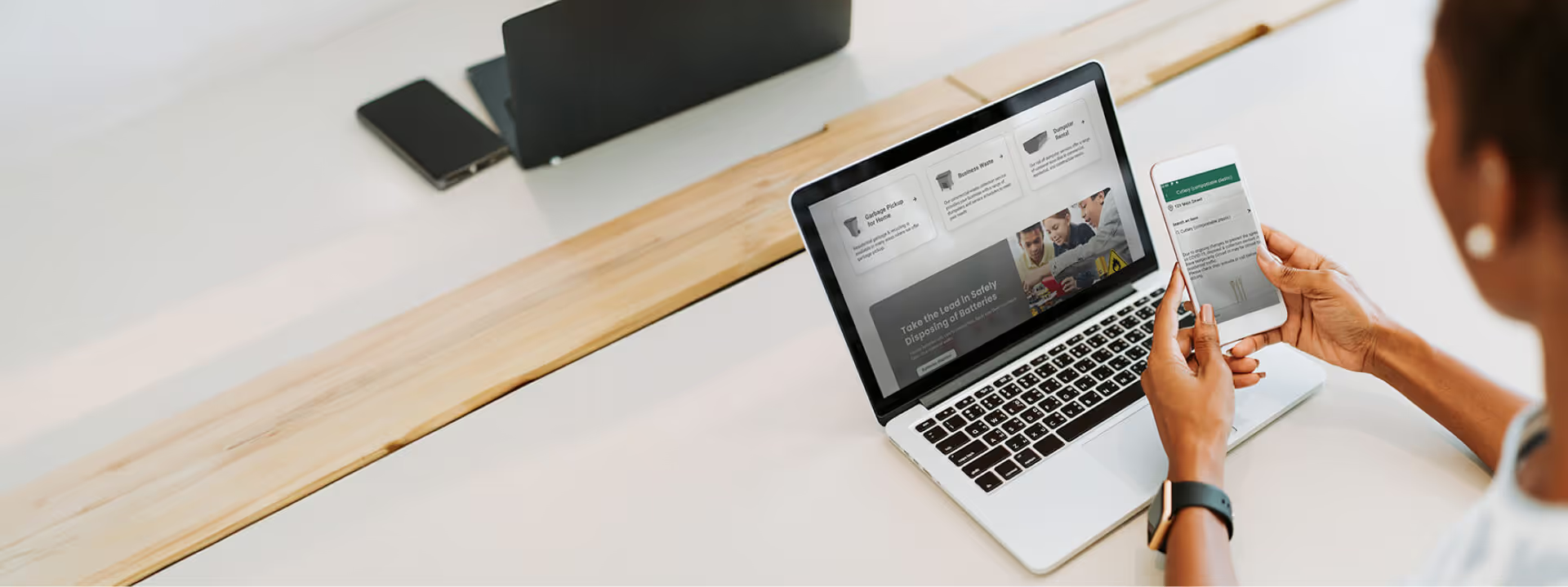
Never Miss Your Collection Day Again With Our App!
Experience the convenience of managing your waste collection right from the comfort of your home with our WasteConnect ™ Mobile App.